From Measurement to Action: How to Build an Effective Performance Management System
Turning Indicators into Results: The SuCh Consulting Approach
At SuCh Consulting, we support industrial companies in the design and implementation of performance management systems that connect strategy with operations and transform data into actionable decisions.
Our conviction is simple: performance does not improve because of indicators themselves, but because of the actions they trigger.
Over the course of our assignments, we have developed recognized expertise in implementing pragmatic, robust, and results-oriented management systems that support operations, Supply Chain, and industrial performance.
Our added value lies in our ability to:
- structure simple and effective management systems
- align strategic objectives with operational realities
- support managers in their performance management practices
- develop a sustainable culture of continuous improvement
- engage teams in change and foster buy-in
- transform performance reviews into true decision-making forums
Our approach covers all components of a performance management system, from process analysis to the implementation of management routines.
Because a performance management system is not merely an indicator project, it is a transformation initiative aimed at making the organization more responsive, more autonomous, and more efficient.
Examples of Results Achieved
Customer service level: one of our clients was facing recurring stock shortages and a service level below 90%. The implementation of a daily order prioritization process, combined with a review of their forecasting and replenishment system, enabled the company to increase its service level to 97% in less than six months.
Production schedule adherence: in one of our client’s manufacturing workshops, delays were identified but rarely addressed at their root cause. The introduction of visual management routines and structured problem-solving practices reduced overdue production orders by nearly 40%.
Inventory reduction: one client had numerous logistics indicators in place, but they were rarely used in day-to-day decision-making. Redesigning the performance management system improved visibility across the flows and reduced inventory levels by more than 15% without negatively impacting the service level.
Looking to Improve the Maturity of Your Performance Management System?
SuCh Consulting experts support industrial companies in the sustainable improvement of their operational performance, Supply Chain, and management practices.
Contact us to discuss your challenges and identify the most relevant improvement levers for your organization.
Introduction
In today’s industrial environments, data has never been so abundant.
ERP, MES, WMS, APS, BI: companies now have access to a considerable amount of information about their operations.
Paradoxically, this explosion of data does not always lead to a comparable improvement in performance.
We regularly encounter companies that produce dozens of dashboards while continuing to face:
- delivery delays
- recurring quality issues
- supply shortages
- capacity constraints
- difficulties in prioritizing actions
- improvement plans that fail to deliver results
The conclusion is often the same: the data exists, but it is not sufficiently transformed into decisions.
At SuCh Consulting, we regularly observe that the highest-performing organizations are not those with the greatest number of KPIs. They are the ones that have built a system capable of quickly turning information into action.
An indicator allows you to observe a situation.
A performance management system allows you to act on that situation.
It is precisely this difference that explains why some companies detect deviations within a few hours, while others only discover them several weeks later.
Why Do So Many Performance Management Initiatives Fail?
Performance management is present in nearly all industrial companies.
Yet many initiatives deliver results that fall short of expectations.
Why? Because many organizations still confuse measurement with management.
The initial objective is often relevant: improving operational visibility.
However, the approach frequently results in:
- the creation of new dashboards
- the addition of new indicators
- the production of increasingly sophisticated charts and reports
Over time, managers find themselves facing dozens of indicators, few of which are actually used to make decisions.
We regularly observe the following issues:
- Indicators without ownership: no one is truly accountable for their performance or evolution
- Non-actionable KPIs: they highlight a problem but do not help identify its root causes
- Performance reviews focused on numbers: discussions center on results rather than defining corrective actions
- Poorly monitored action plans: actions are identified but rarely managed through to completion
- Limited ownership by teams: indicators are viewed as reporting tools rather than improvement levers
Conversely, the highest-performing companies generally rely on a limited number of indicators, but they use them as genuine management tools.
1. Why Performance Management Is Essential
An Industrial Environment Under Constant Pressure
Industrial companies now operate in a particularly demanding environment.
Supply Chain and Operations leaders must simultaneously cope with:
- increasingly demanding customer expectations
- higher quality requirements
- labor and workforce constraints
- rising energy costs
- more complex supply chains
- growing environmental challenges
In this environment, experience alone is no longer sufficient.
Decisions must be based on objective facts and reliable data.
The ability to quickly detect a deviation has become a key competitive advantage.
Let us take a simple example. A decline in service level can have several causes:
- a supplier shortage
- a planning issue
- a production failure
- a picking error
- a transportation issue
Without a structured performance management system, quickly identifying the root cause becomes extremely difficult… and in the meantime, the consequences continue to spread.
Measuring Does Not Mean Managing
One of the most common misconceptions is the belief that the presence of indicators guarantees effective performance management.
However, many companies measure performance without truly managing it.
KPIs are often:
- reviewed after the fact
- analyzed several days or weeks after events occur
- poorly connected to operational decisions
- insufficiently linked to root causes
The outcome is predictable: problems are identified but rarely solved in a sustainable way.
The real question is therefore not “Which indicators do we monitor?” but rather “What do we do when these indicators deviate?”
This is where the boundary between measurement and performance management truly lies.
Reaction Speed Becomes a Competitive Advantage
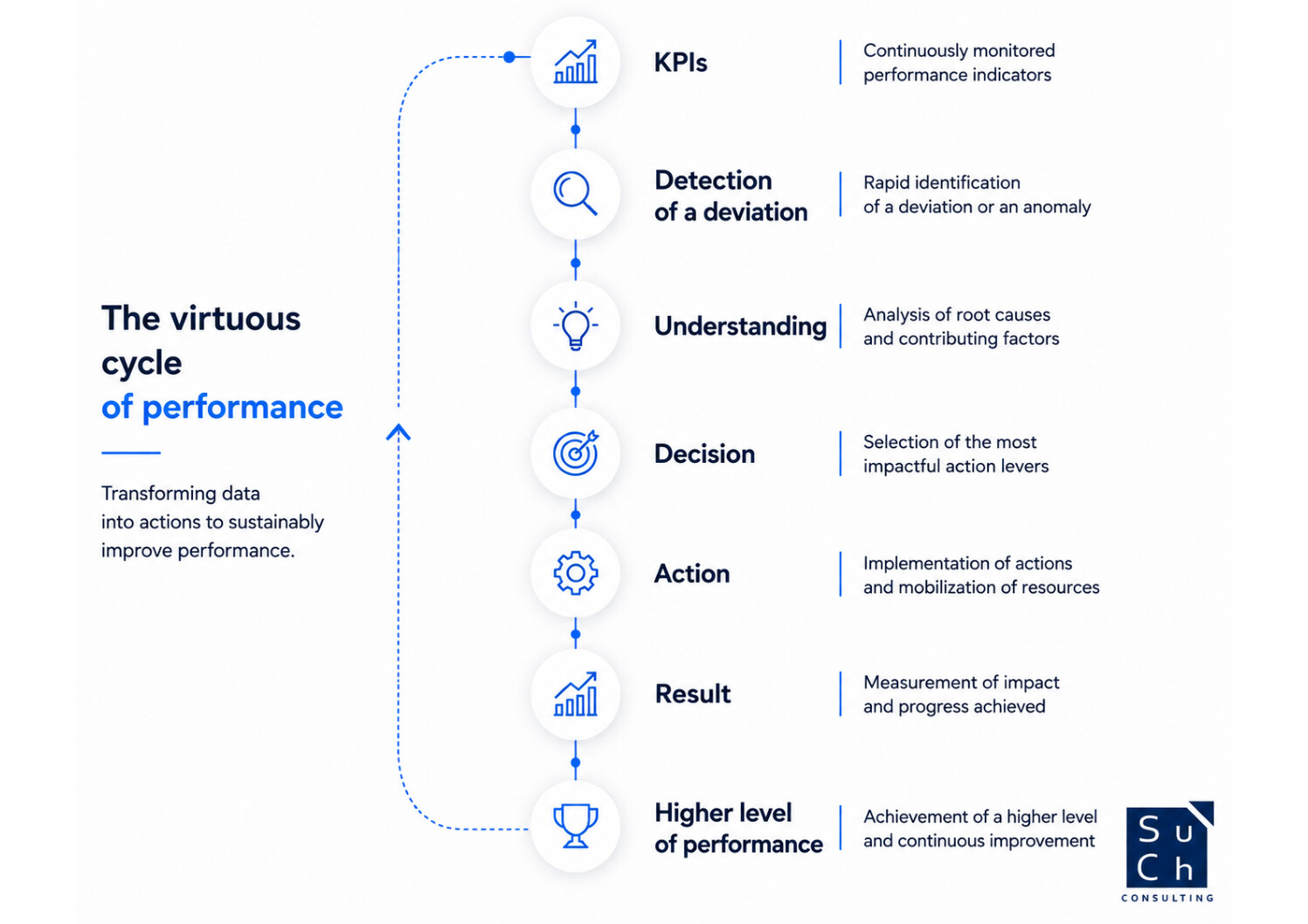
A high-performing organization must be able to answer three questions quickly:
- Where do we stand: what is the actual state of performance?
- Why are we deviating: what are the root causes of the problem?
- What do we do now: which actions must we implement immediately?
This sequence may appear simple, yet it is precisely where a significant part of operational performance is determined.
The highest-performing organizations are those that shorten this cycle as much as possible:
2. What Is a Performance Management System?
A performance management system is a set of practices, tools, and routines designed to align the organization’s activities with its objectives.
Its purpose is not to produce information, but to support decision-making.
The Three Fundamental Pillars
Every performance management system relies on three complementary dimensions:
- Measure: collect reliable and relevant data
- Understand: analyze deviations and identify their root causes
- Act: define, implement, and monitor corrective actions
When one of these three dimensions is missing, the system loses its effectiveness.
The Link Between Strategy and Operations
One of the primary roles of a performance management system is to ensure that the company’s strategy is translated into the day-to-day activities carried out on the shop floor.
We often represent this logic as a pyramid:
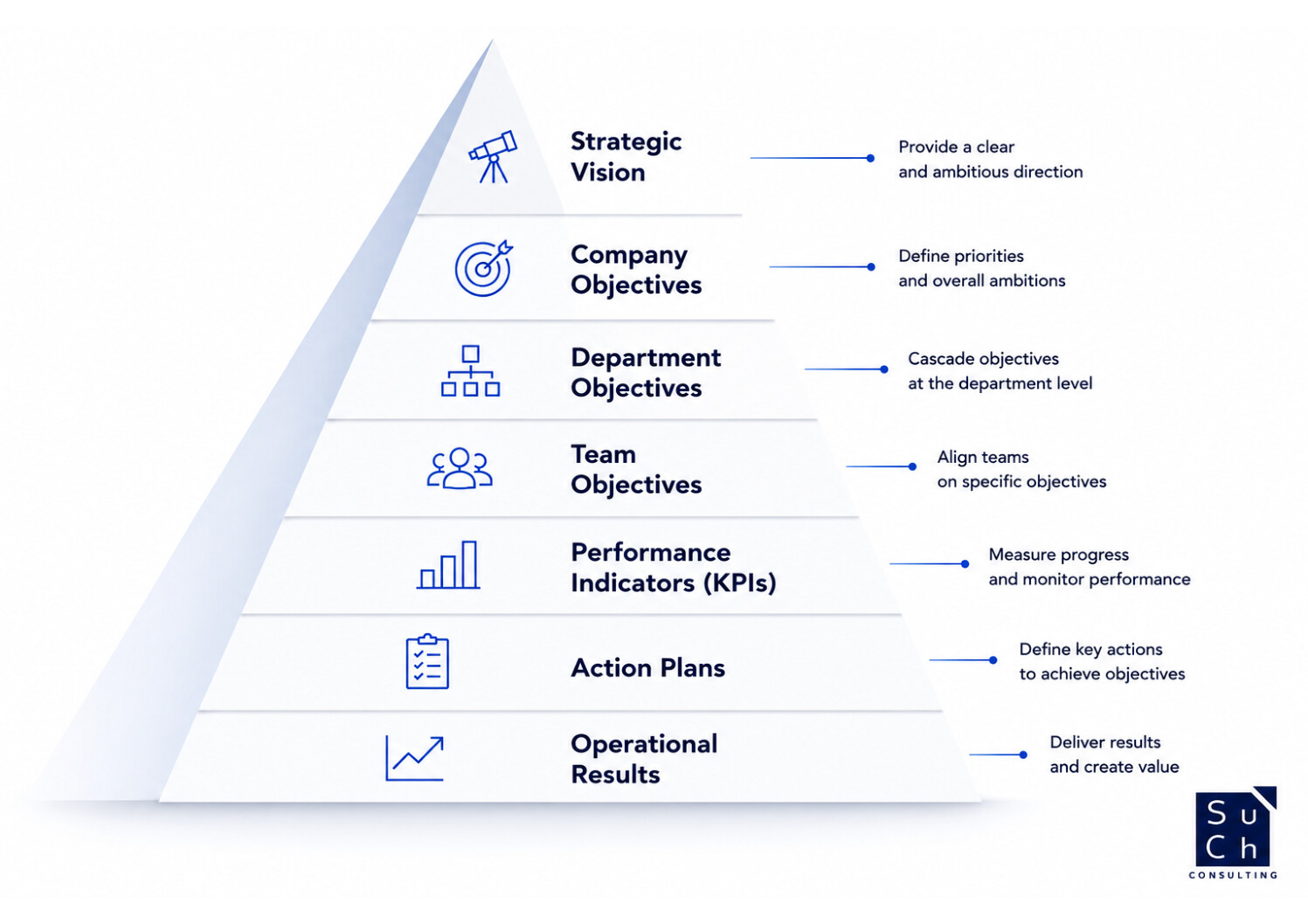
When this cascading process works properly, every employee understands:
- what is expected of them
- why it is important
- how their contribution impacts overall performance
Conversely, when this link disappears, teams may optimize their local indicators while negatively affecting overall performance.
The Essential Role of Visual Management
Visual management is one of the pillars of an effective performance management system.
Its objective is simple: make deviations immediately visible.
Good visual information should enable any employee to understand within a few seconds:
- whether the situation is under control
- where the problem lies
- what action needs to be taken
Visual management is not about producing complex dashboards; it is about simplifying decision-making.
Today, many companies rely on digital solutions such as Power BI, Tableau, Monday.com, and iObeya to consolidate their indicators, digitalize management routines, and facilitate collaboration between teams.
These tools are excellent accelerators when they are integrated into a structured performance management approach. However, their effectiveness primarily depends on the relevance of the indicators, the quality of management routines, and the ability of teams to quickly transform observed deviations into decisions and concrete actions.
A Continuous Improvement Loop
Performance management is based on a continuous improvement mindset.
Every detected deviation should become an opportunity for learning.
The cycle is as follows: Measure → Understand → Act → Verify → Standardize.
This loop progressively improves processes and increases the organization’s level of control and maturity.
3. The 6 Dimensions of Industrial Performance
One of the most common mistakes is to reduce performance to a single dimension: costs.
At SuCh Consulting, we favor an SQCDPE approach that enables performance to be assessed in a comprehensive manner:
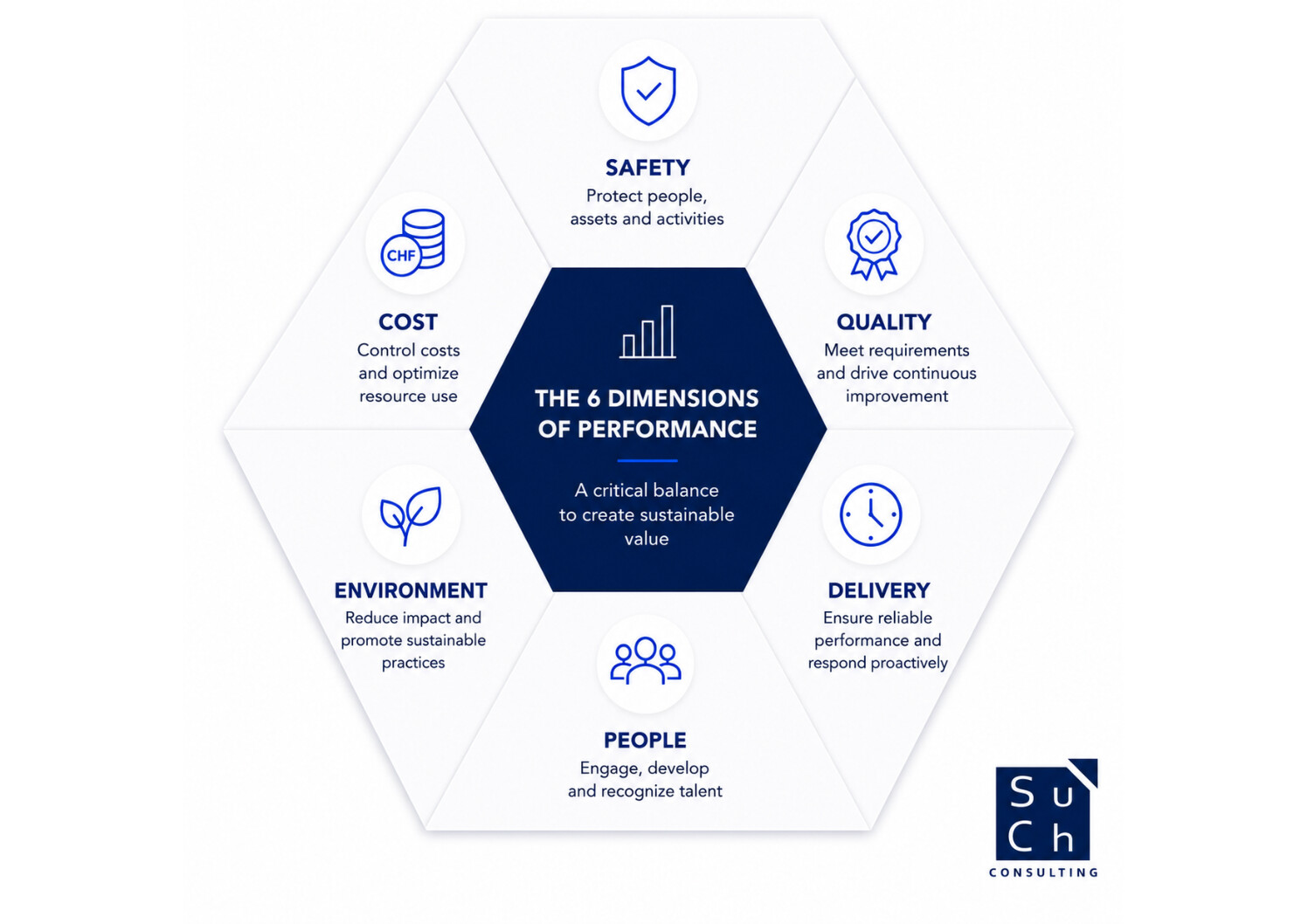
This 360-degree perspective helps prevent local optimizations that negatively impact overall performance.
For example:
- reducing inventory may deteriorate service levels
- increasing productivity may raise quality risks
- accelerating lead times may create additional safety risks
- reducing headcount may weaken employee engagement
The objective is therefore not to optimize a single dimension in isolation, but to find the right balance between these six components.
4. How to Deploy an Effective Performance Management System
Implementing a performance management system is neither about creating dashboards nor about purchasing a new tool.
At SuCh Consulting, we have developed a pragmatic and proven methodology that enables organizations to build a performance management system based on the reality of their processes.
We deployed this approach within the teams of one of our clients in the watchmaking industry, involving more than 500 employees.
The department already had numerous indicators, reliable data, and experienced teams.
The main challenge was not to measure more, but rather to harmonize management practices, create a common language around performance, and strengthen the organization’s ability to quickly detect deviations, make decisions, and take effective action.
Step 1: Understand the Processes Before Trying to Measure Them
One of the most common mistakes is to define indicators before fully understanding the underlying processes.
However, it is impossible to effectively manage a system that is not fully understood.
This is why our projects systematically begin with a process mapping phase.
This step makes it possible to understand: which activities are performed, in what sequence they occur, what the physical and information flows are, the roles and responsibilities involved, the expected deliverables, and the key decision points.
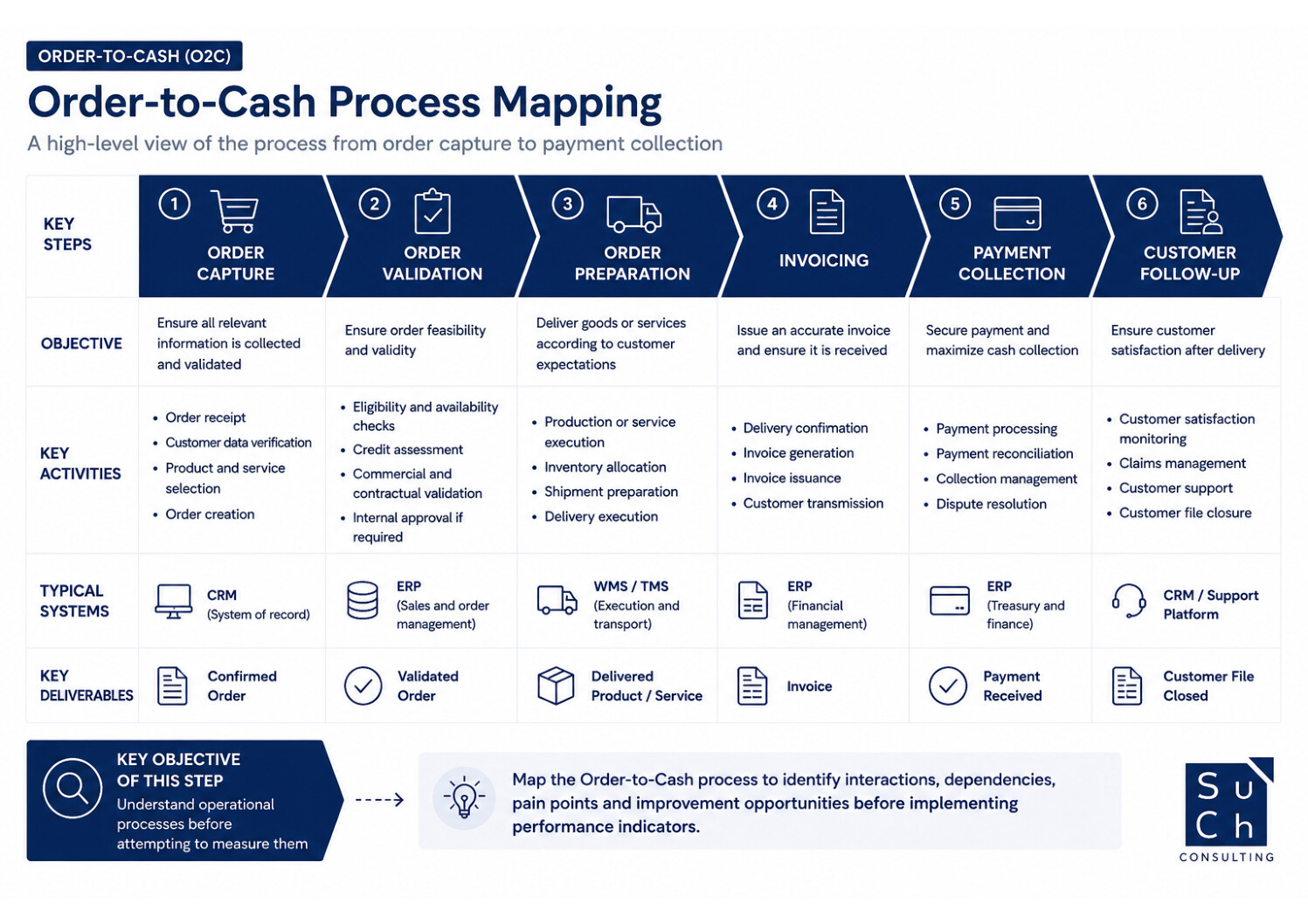
As part of the watchmaking project, dozens of processes were analyzed to understand the interactions between teams, production flows, and decision-making mechanisms.
This phase made it possible to identify several gaps between the theoretical processes and the practices actually observed on the shop floor. These findings led to process optimization initiatives aimed at simplifying flows, reducing inefficiencies, and sustainably improving performance.
As in many industrial organizations, some critical activities were poorly measured or not measured at all, while others were monitored in great detail but were rarely used in day-to-day management.
Process mapping therefore became a powerful alignment tool between teams and managers.
Step 2: Identify the Measurement Points That Truly Matter
Once the processes have been understood, the next question becomes: where should we measure?
Contrary to popular belief, it is neither necessary nor desirable to measure every activity.
The most effective systems generally rely on a limited number of indicators positioned at strategic points within the process.
We often compare these indicators to sensors installed along a production line.
Their role is to provide rapid visibility into:
- the overall health of the process
- bottlenecks and blocking points
- capacity constraints
- performance deviations
- operational risks
Within the watchmaking manufacturer, this work enabled managers to focus their attention on the factors that truly drive the department’s overall performance and to avoid the proliferation of indicators that are rarely used in decision-making.
A good performance management system does not seek to measure everything; it seeks to measure what enables better decisions and continuous improvement.
Step 3: Build Indicators That Truly Drive Action
Once the measurement points have been identified, the next step is to build the indicators. This phase is often underestimated, even though it directly determines the quality of future decisions.
At SuCh Consulting, we systematically apply three fundamental principles:
- An indicator must be simple: every employee should immediately understand what is being measured, how it is calculated, and why it matters
- An indicator must be reliable: when teams begin to question the data, they stop using the indicator. Discussions then focus on the numbers rather than on the problems that need to be solved
- An indicator must be actionable: knowing that a service level has dropped from 98% to 92% is useful. Understanding whether this deterioration originates from supply, production, order preparation, or transportation is far more valuable
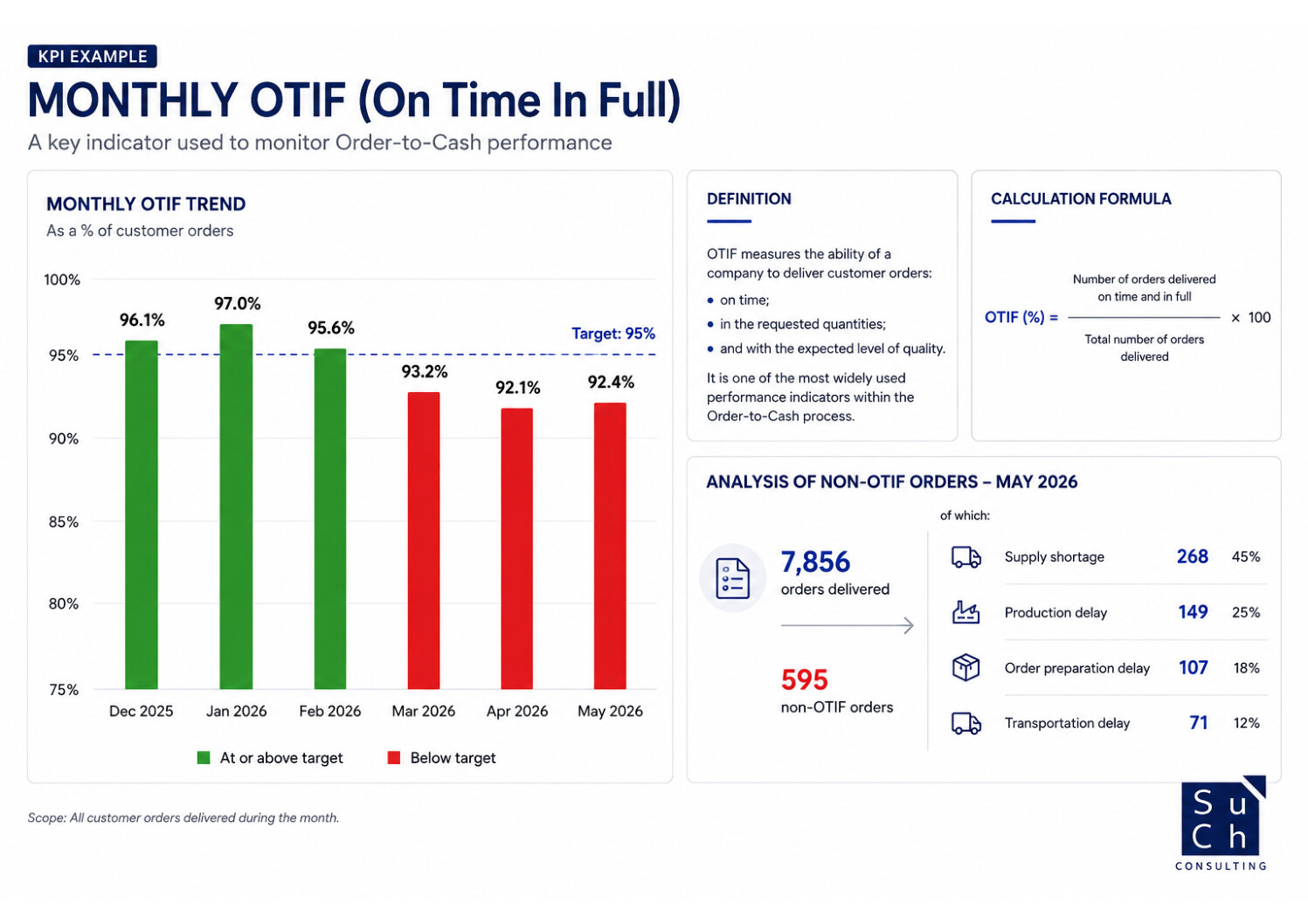
In the watchmaking project, this approach led to the structuring of the entire performance management system around the SQCDPE model: Safety, Quality, Cost, Delivery, People, and Environment.
This common framework enabled all teams to share a consistent view of performance.
Step 4: Transform Data into Actionable Information
In most companies, data already exists across different systems: ERP, MES, WMS, Excel files, or internal databases.
A significant part of the project therefore consists of extracting, cleansing, validating, consolidating, and transforming this data into meaningful indicators.
As part of the watchmaking project, substantial work was carried out to make information easily accessible to managers and to reduce the time spent collecting and manually consolidating data.
This step is often decisive, as an effective performance management system primarily relies on reliable data, and poor data almost always leads to poor decisions.
Step 5: Deploy Visual Management and Management Routines
Once the indicators have been developed, they must be made visible.
Visual management serves as the link between data and teams.
Its objective is simple: to enable everyone to understand the situation within a few seconds.
A good visual management board should immediately answer the following questions:
- Are we meeting the target?
- Where is the deviation?
- How significant is it?
- Who is responsible?
- What action is being taken?
The best management dashboards are often the simplest.
They emphasize trends, deviations, alerts, and actions rather than an accumulation of figures.
Within the watchmaking manufacturer, several levels of performance reviews were implemented: daily, weekly, monthly, and quarterly.
This structure made it possible to improve the escalation of issues, accelerate decision-making, and strengthen alignment across the different levels of management.
Step 6: Train Teams and Develop a Continuous Improvement Culture
A performance management system only works when it is understood and used by the teams.
This dimension is often overlooked, even though it is one of the main success factors.
In our projects, we devote a significant portion of the effort to developing the skills of managers and employees.
Training programs typically cover:
- the fundamentals of performance management
- the SQCDPE model
- reading and interpreting indicators
- deviation analysis
- problem-solving techniques
- developing and monitoring action plans
- the principles of continuous improvement
In the watchmaking project, this phase played a decisive role in the teams’ adoption of the system and in harmonizing management practices across more than 600 employees.
Key Takeaways
The deployed system made it possible to:
- improve visibility into the causes of underperformance
- accelerate decision-making
- harmonize management practices
- strengthen team accountability
- sustainably foster a shared culture of performance and continuous improvement.
The main lesson from this project is one that we encounter across all of our assignments:
Performance does not improve because of indicators; it improves because of the decisions and actions that these indicators make possible.
Tools are necessary, data is essential, but it is ultimately the people within the organization who create sustainable performance.
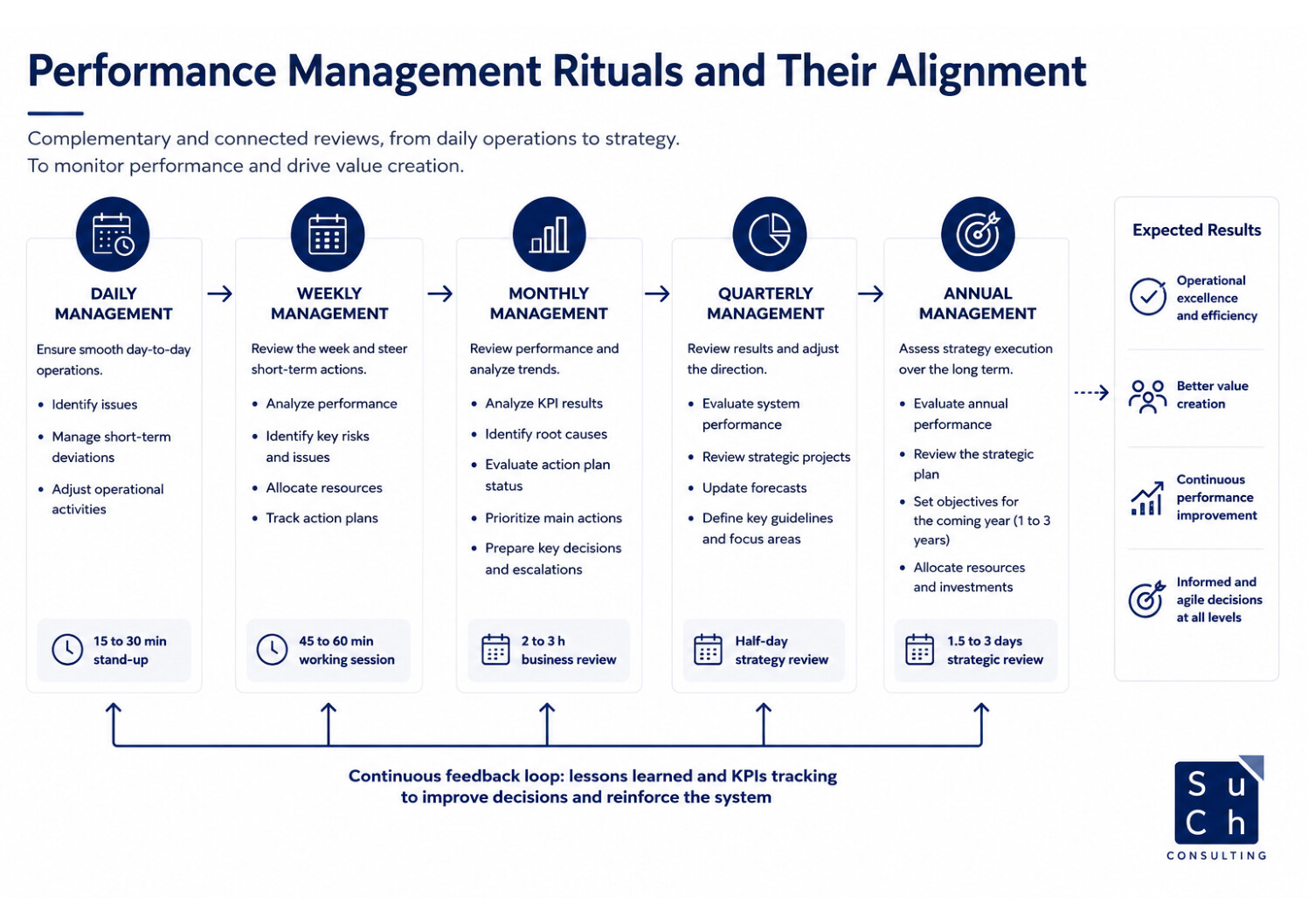
5. Performance Reviews: The True Engine of the System
Many companies focus their efforts on creating indicators. However, the value does not lie in the KPIs themselves, but in the discussions and decisions they generate.
Performance reviews are therefore the true engine of the system.
Daily Management
Daily reviews are designed to address immediate operational deviations and are generally brief, lasting between 10 and 15 minutes.
Their objective is simple:
- identify problems
- define actions and implementation deadlines
- assign responsibilities
Weekly Management
The weekly level provides greater perspective.
The topics discussed often include:
- performance trends
- recurring root causes
- resource allocation decisions
- improvement actions
Monthly Management
The monthly level connects operations with strategy.
Managers review:
- the evolution of performance indicators
- achievement of objectives
- future priorities
- required investments
Quarterly and Annual Management
These levels make it possible to assess:
- the maturity of the system
- the progress achieved
- future directions and priorities
They ensure alignment between the company’s strategy and operational execution.
6. The Most Common Mistakes
After several dozen transformation projects at SuCh Consulting, we regularly encounter the same mistakes.
Mistake #1: Multiplying indicators
The more indicators there are, the less they are used. High-performing organizations focus on a limited number of essential KPIs.
Mistake #2: Building indicators disconnected from decisions
An indicator that does not trigger any action creates no value.
Mistake #3: Neglecting data quality
Confidence in the indicators is an absolute prerequisite. As soon as teams begin to question the figures, the system loses credibility.
Mistake #4: Managing performance only through a top-down approach
Performance is built closest to the shop floor. Teams must actively participate in analysis, decision-making, problem-solving, and the continuous improvement of their activities.
Mistake #5: Confusing reporting with management
Reporting answers the question: what happened?
Performance management answers the question: what do we do now?
This distinction is fundamental.
Mistake #6: Failing to follow actions through to completion
This is probably the most common mistake.
Many organizations correctly identify problems, but they do not sufficiently manage corrective actions.
Performance does not improve simply because a problem has been identified; it improves when the root causes have been permanently eliminated.
Conclusion
In an industrial environment characterized by increasing complexity, the ability to effectively manage performance has become a major competitive advantage.
Yet many organizations still confuse measurement with management.
They invest in tools, develop new dashboards, and generate ever more indicators.
However, sustainable performance does not result from the quantity of information available; it results from the ability to quickly transform that information into decisions and then into actions.
An effective performance management system makes it possible to:
- align strategy and operations
- quickly detect deviations
- identify root causes
- accelerate decision-making
- embed continuous improvement into the daily work of teams
In other words, it enables organizations to move from a reporting mindset to a management mindset.
And it is precisely this transition that today makes the difference between organizations that suffer from their performance and those that truly master it.